


Motorola

Motorola's new Edge Adds Tele Camera, Among Other Upgrades
Motorola has announced the 2025 edition of its mid-range "edge" phone model. Like most previous generations, it has a curved-edge display, which measures 6.7 inches and has "Super HD" resolution of 1220 x 2712 pixels, with 120 Hz refresh. The battery is now larger, with an unusual 5,200 mAh capacity. It also can charge at up to 68W with the right charger, and has wireless charging. The waterproof rating has been upped to IP69 and it now has military ratings for ruggedness. The camera system has an added telephoto camera (10 megapixel, 3x optical) accompanying a 50 megapixel main camera and wide-angle/macro lens. The processor is now a MediaTek Dimensity 7400, but memory stays the same at 8 GB RAM and 256 GB storage. A new, dedicated AI button on the side can trigger Motorola's unique AI features like "Catch Me Up", which summarizes missed notifications. The front is protected by Corning Gorilla Glass 7i, while the back is a "soft leather-inspired finish". The phone comes in one color at launch: a dark green that Pantone call Deep Forest. It will launch unlocked on June 5th for $550, and will also come to T-Mobile, Metro by T-Mobile, Total Wireless, Visible, Spectrum, and Xfinity Mobile.

Hands On with the New Moto Edge
Motorola is rounding out its 2025 lineup of phones with the new edge (2025). This mid-range phone has a fancy curved-edge display that gives it a unique look and feel. It helps the phone have thinner bezels, and look and feel extra-thin. What's it like in person? Read on for our hands-on report.


Google "Find Hub" Replaces Find My Device
Google is revamping its find-my-device services into a new Find Hub. The new features will be able to find a lost Android device, or anything with a Google-compatible Bluetooth tracker attached. It can also be used to keep to share your location with family and friends. It's also gaining support for UWB (for high-end phones with that feature). Motorola's Bluetooth trackers will be the first to work with UWB. This feature lets you locate your lost item very precisely — including not just proximity but direction — when nearby. Finally, Google is working to integrate satellite connectivity into Find Hub, "helping you stay connected with friends and family even when you don’t have cellular connectivity."

Moto Intros razr Ultra, its New Flagship Foldable
Motorola has introduced a fully flagship-level foldable phone with the new razr Ultra. It borrows its design from the existing razr+, with the only obvious external difference being a new AI button on the side, and new finish options including brushed metal sides and real wood (shown) or Alcantara synthetic suede on the back. The specs have all been bumped up compared to the razr+, including the top-end Snapdragon 8 Elite chipset, 16 GB of RAM, up to 1 TB of storage, brighter and sharper (Super HD) main display, larger 4,700 mAh battery, faster 68W wired charging, faster 30W wireless charging, and triple 50 megapixel cameras (including a main with a top-end Sony sensor, a wide-angle, and the inner camera). Motorola also introduced 2025 versions of the razr and razr+, although they have minimal changes compared to the 2024 models. The razr has a slightly updated processor, and all three models have new titanium hinge mechanism that Motorola claims is 4x stronger. On the software side, Motorola has updated its Moto AI to include multiple chatbots, including Meta Llama, Google Gemini, Perplexity, and Microsoft Copilot. Meta's Llama can run on-device to power privacy-sensitive AI features of Moto AI, like "Catch Me Up", which summarizes your notifications. The new razr models launch in mid-May. Both T-Mobile and AT&T will offer the new razr+ and razr Ultra. Just about every US carrier except AT&T will offer the more-affordable razr 2025. The razr Ultra will retail for $1300, the razr+ for $1000, and the razr for $700.

Hands On with the 2025 Moto razr Lineup
Motorola has new razr flip foldable phones for 2025, and this year there are three — including, perhaps for the first time — a truly flagship-class model. They have a whole lot in common with last year's models, and in fact are difficult to tell apart from the old models, and even from each other. But they have interesting new colors, materials, and textures, and some updates to both the hardware and software. The most important part — the hinge — is a an all-new design in all three. Of course, they're loaded up with more AI features than ever. What else should you know? What are they like in person? Read on for our hands-on report.


This Year's moto g stylus is a Better Value
Motorola has revealed the 2025 edition of the $400 phone in its lineup: the moto g stylus. This year's model supports super-fast 68W charging, up from 30W last year (the 68W charger is sold separately). Motorola claims the 68W charging can give the phone a day's worth of power in just 15 minutes. The 2025 model also adds IP68 waterproofing and military-grade ruggedness ratings. The display is also sharper, with a unique resolution of 1220 x 2712 pixels, which Motorola calls "Super HD". The processor has been upgraded to a Snapdragon 6 Gen 3, and the Wi-Fi is faster with support for Wi-Fi 6E. Naturally, it has a built-in stylus, which Motorola claims is now 6.4x more responsive. Like last year's model, it has a 50 megapixel main camera with OIS, 13 megapixel wide-angle camera, and 32 megapixel front camera. What looks like a third camera is actually a 3-in-1 light sensor for the camera system. The phone comes with 8 GB RAM and either 128 or 256 GB of storage, with a memory card slot for adding up to 1 TB of storage. It also has a 5,000 mAh battery, wireless charging (15W), and a 3.5mm headset jack. This year's color options are PANTONE Gibraltar Sea (navy) and PANTONE Surf the Web (bright purple). The moto g stylus (2025) will be available unlocked starting at $400 on April 17th. It will also be offered by Metro, Verizon, Visible, Total Wireless, Straight Talk, AT&T, Cricket, Spectrum, Consumer Cellular, UScellular, Xfinity Mobile, Google Fi, Optimum, and Boost.

Motorola Refreshes Entry-Level Phones for 2025
Motorola has revealed the moto g 2025 and moto g power 2025. Both models are very similar to their 2024 counterparts, just with slightly larger displays (by 0.1 inch) and a more waterproof and rugged design for the moto g power. The moto g 2025 also gets front camera upgrade. Both are affordable 5G phones, with the new moto g retailing for $200 and the moto g power going for $300. Both new models are powered by the MediaTek Dimensity 6300 chipset. Both have an LCD display with 120 Hz refresh, 128 GB of storage (expandable), 50 megapixel main camera, 16 megapixel front camera, fast charging of at least 25W, NFC, fingerprint reader, stereo speakers, and a 3.5mm headset jack. For the extra $100, the moto g power 2025 offers wireless charging, a slightly larger, sharper display (6.8" FHD+ instead of 6.7" HD+), double the RAM (8 GB vs. 4 GB), and a body that's fully waterproof (IP69) and ruggedized to military standards. The moto g will come in Forest Gray or Sapphire Blue, while the moto g power will come in Leaf Green or Slate Gray. Both models will be offered by T-Mobile, Metro by T-Mobile, AT&T, Cricket, Straight Talk, Total Wireless, Walmart for Verizon, and UScellular "in the coming months". The new moto g will also come to Boost Mobile, XFinity Mobile, Consumer Cellular, Google Fi Wireless, Spectrum, and Optimum Mobile, while Consumer Cellular will offer the new moto g power. Both models will also be available online, unlocked, from motorola.com, in late January / early February.

Moto Dresses the razr+ in Pantone's New Color of the Year: Mocha Mousse
Pantone has dropped its Color of the Year for 2025: Mocha Mousse. As in recent years, Motorola has partnered with Pantone to launch special edition phones in the color. In the US, it will be the razr+ (2024). The phone will be available exclusively from motorola.com starting December 19. While the list price remains $1,000, Motorola is offering $200 off for a limited time, bringing the price down to $800. In other parts of the world, the company will offer the razr 50 ultra and edge 50 neo in Mocha Mousse.

HMD Fusion Enables Functional Smart Cases
HMD's newest phone — the HMD Fusion — has a special six-pin connector the enables new kinds cases that add to the phone's functionality. HMD calls these enhanced cases "Smart Outfits". HMD is rolling out several of its own, while also releasing an open-source developer kit for others to make their own Smart Outfits. HMD's first option is the Flashy Outfit, which adds a ring light to the camera area. The light is on a hinge to be adjustable, and the light output can be customized via the phone's built-in camera app. A Rugged Outfit adds IP68 protection as well as wireless charging and an SOS button. HMD also promises a gaming Outfit, and says at least one third party is committed to making their own Outfit for vertical solutions. HMD envisions potential other Outfits including e-ink or solar charging. The Fusion is also easily repairable, including the display and battery. HMD is committing to making parts available for seven years, although it only promises software security updates for three years. The Fusion is powered by a Qualcomm Snapdragon 4 Gen 2 chipset with 5G, with 6 GB RAM and 128 GB storage (expandable). It has a 108 megapixel main camera and 50 megapixel front camera. The display measures 6.56" with 90 Hz refresh, and the battery is 5,000 mAh. The phone has 33W fast charging, NFC, fingerprint reader, and a 3.5mm headset jack. The Fusion comes with a simple clear case. The HMD Fusion will be available in the US later this year for $299. Motorola tried a similar concept with Moto Mods in 2016.

Moto Tags Now Available
Motorola's new Moto Tags go on sale starting today, available from motorola.com and amazon.com. Moto Tags use the new, Bluetooth-based Google Find My Device network and include UWB for short-range, precision location. Moto Tags are similar to Apple AirTags and work with most Android phones. They also support cross-platform protections against unwanted tracking (stalking). Moto Tags are rated IP67 for dust and water, and use the same CR2032 battery as AirTags, designed to last one year. Moto Tags have a button, which can be used to ring a lost phone, or trigger your phone's camera. Moto tags sell for $30 each, or $100 for four. Chipolo and Pebblebee also make tags compatible with the new Google Find My Device network.
Pink Motorola razr+ Exclusive to T-Mobile
T-Mobile will have an exclusive on the "hot pink" color for the new Motorola razr+ flagship foldable phone in the US. Pre-orders start tomorrow, July 10.
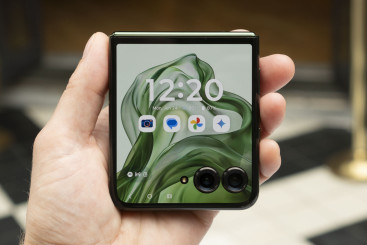
Hands On with the Motorola razr and razr+ (2024)
Motorola has a refreshed pair of razr foldables for 2024 and they come with a solid set of upgrades over last year's models. Most notably, the $700 model now has a full-size outer display, making it look much more like a premium foldable while offering considerable functionality. There are plenty of other upgrades to talk about, and there's a lot of unique software to explore. And what are they like to hold and use in person? We'll cover it all in this hands-on report with our first impressions of both phones.


Motorola Upgrades its razr Foldables Across the Board
Motorola has revealed its new razr and razr+ foldable phones for 2024. While the price points are unchanged at $700 and $1,000, both models get important upgrades. The most obvious and important is that the cheaper model now has the same large (3.6-inch) OLED touch display on the outside as last year's plus model, offering extensive functionality while closed. Both models also get the same new and improved main camera with 50 megapixel resolution and OIS, and much better waterproofing (IPx8 to withstand full immersion). Both also share a new hinge design that's 30% smaller while offering better reliability, stability, dust resistance, and "crease" resistance. Both have Gorilla Glass Victus protecting the outer display and a similar 6000-series aluminum frame. Both have a 6.9-inch flexible main display inside with FHD+ resolution, and HDR10+. Other features in common include Google Gemini AI pre-installed, 256 GB of storage, 15-watt wireless charging, Bluetooth 5.4, and a 32 megapixel internal camera.
- The razr (2024) has a 3.6-inch outer touch display and both displays have 120 Hz refresh. It's powered by a MediaTek Dimensity 7300X chip and 8 GB of RAM. The battery is 4,200 mAh and it fast-charges at up to 30 watts. The second camera remains a 13-megapixel wide-angle one. Wi-Fi is version 6E. Color options include grey, sand, and orange. (Grey will be most common in the US.) The back is a smooth "vegan suede" texture.
- The razr+ (2024) has an even larger 4-inch outer display and both displays have up to 165 Hz refresh. It's powered by a Qualcomm Snapdragon 8s Gen 3 chip and 12 GB of RAM. Both the RAM and storage are faster than on the base model (LPDDR5x and UFS 4.0). The battery is 4,000 mAh (larger than last year), it fast-charges at up to 45 watts, and the wireless charging is two-way. The second camera is a 2x telephoto instead of wide-angle, with 50 megapixel resolution but no OIS. Wi-Fi 7 is supported. Color options include blue, green, peach, and pink. (Blue will be most common in the US, with a vertical "racing stripe" of smoother texture in the "vegan leather".)

T-Mobile Picks up the New Motorola Edge
Motorola has taken the wraps off the 2024 edition of its mid-range Edge phone. True to its name, this year's model has an "endless edge" design with a 6.6-inch pOLED display that curves at the sides. Other key specs include 144 Hz display refresh, Snapdragon 7s Gen 2 processor, 8 GB RAM, 256 GB storage, IP68 water rating, and a 50 megapixel camera with a Sony Lytia 700C sensor and OIS. The 5,000 mAh battery can fast-charge at up to 68 watts, or 15 watts wireless. There's also a 13 megapixel wide-angle camera, 32 megapixel front camera, and a customizable shortcut button on the side. The back is "vegan leather" in Midnight Blue. It will be carried by T-Mobile, Metro by T-Mobile, Spectrum, Consumer Cellular, Straight Talk, Total By Verizon, and Visible. Motorola will also sell it unlocked for $550 starting June 20th.

Motorola Gives its Stylus Phone a Spec Bump
Motorola has revealed the 2024 edition of its moto g stylus 5G, a model that typically sits near the upper end of its moto g series of affordable phones. The new model addresses most shortcomings of last year's model, adding wireless charging and boosting the wide-angle camera resolution from 8 megapixel to a more-useful 13 megapixel. The selfie camera also gets a boost, from 16 megapixel to 32, and RAM gets a nice bump to a generous 8 GB. Wired charging is also faster at up to 30 watts instead of 20. Other specs remain similar, including the large AMOLED display with 120 Hz refresh, pop-out stylus, Snapdragon 6 Gen 1 chipset, and 5,000 mAh battery. There's also NFC, expandable storage, and a headset jack. The body is water repellent with an IP52 rating, slightly thinner than last year's model, and has a "vegan leather" finish on the back. Motorola will sell it unlocked for $400 starting May 30th. It will also be offered by AT&T, Metro by T-Mobile, Cricket, Boost, Consumer Cellular, US Cellular, Spectrum, Xfinity Mobile, Google Fi, Optimum Mobile, Straight Talk, Total by Verizon, and Visible.

Motorola Brings More Affordable 5G Phones to its 2024 Lineup
Motorola has announced the 2024 editions of the moto g 5G and moto g power 5G, priced at $200 and $300, respectively (MSRP, unlocked). Both phones offer 5G, a vegan leather finish on the back, 120 Hz display refresh, 50 megapixel main camera, 5,000 mAh battery, 128 GB storage (expandable), NFC, fingerprint reader (on the side), and a headset jack. For the moto g 5G, NFC is a key addition compared to last year's version. For the extra $100, upgrades on the moto g power 5G (compared to the moto g 5G) include a sharper display (FHD+ instead of HD+), double the RAM (8 GB instead of 4), better front camera (16 megapixel instead of 8), an 8-megapixel wide-angle camera (instead of 2-megapixel macro), faster charging (30-watt instead of 18), and wireless charging. Compared to last year's moto g power 5G, improvements include more RAM, the wide-angle camera, NFC, wireless charging, and faster wired charging. Verizon, AT&T, and T-Mobile will all offer both phones. The moto g 5G (2024) will come to T-Mobile and Metro by T-Mobile first, on March 21st. Boost, Consumer Cellular, Cricket, TracFone, US Cellular, Xfinity, Google Fi, Optimum, Cox, Straight Talk, Total by Verizon, Simple Mobile, Walmart Family Mobile, and Visible will also offer it. The moto g power 5G (2024) will launch with Cricket on March 22nd, and later with Metro, US Cellular, Straight Talk, Total by Verizon, Walmart Family Mobile, and Visible as well. Motorola's g series for 2024 also includes the already-announced, 4G-only moto g play (2024), which retails for $150.
Motorola Commits to Gorilla Glass on All Phones
Motorola announced that its entire lineup of phones will feature Corning Gorilla Glass starting in the second half of this year. Gorilla Glass is widely used on higher-end smartphones and known for its toughness and durability. Different versions of Gorilla Glass offer different properties. Gorilla Glass 3 focuses on scratch resistance, while Gorilla Glass 5 and 6 are optimized to protect against damage from drops. Gorilla Glass Victus is designed for both, and Gorilla Glass Victus 2 further improves drop performance on rougher surfaces like concrete.
Motorola to Seamlessly Link Phones with Lenovo Laptops and Tablets
Motorola and Lenovo have announced Smart Connect, a set of software features that will intelligently link various device types to function as a seamless suite. Cross control lets a single keyboard and mouse navigate between your PC, tablet, and phone. Swipe to stream lets you move a video stream or podcast to a different device and pick up right where you left off. Notification sync puts your notifications on all of your devices. Share hub lets you "access and share large files across connected devices without taking up tons of storage." Smart clipboard lets you copy and paste across devices. Webcam lets you use the superior camera on your smartphone for video calls or livestreams on another device like a laptop or PC. Smart Connect will be available "in the coming months".
Bullitt Shuts Down
Bullitt — the UK company behind CAT-branded phones, recent Motorola Defy phones, and its own satellite message service — has apparently ceased operations. The company recently tried to reorganize around the new satellite connectivity business, but that effort appears to have failed. The company has disclosed its pending insolvency in recent press statements and court filings. Now, multiple employees have posted on LinkedIn that a "critical planned restructuring" has failed and the company closed its doors and laid off all employees on January 26th. Between this development and Qualcomm giving up on Snapdragon Satellite, the last few months have called into question the future of phone-based solutions for satellite connectivity. Apple remains committed to this approach for its SOS service, and MediaTek continues to promote its standards-based NTN solution. However, the most momentum over the past year has been around satellite-based solutions that work with existing phones. Both AT&T and T-Mobile appear to be nearing the launch of such services, having recently announced successful tests.
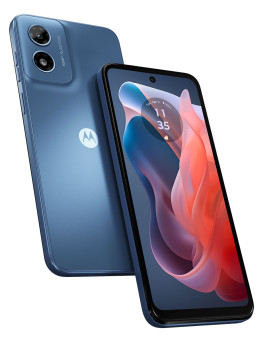
Moto Gives its Affordable g play More Value
Motorola is launching a new version of its affordable moto g play phone for 2024. Last year's model was popular with carriers; this year's model appears to be just as popular, with AT&T, Verizon, Cricket, Consumer Cellular, U.S. Cellular, Xfinity Mobile, and more already announcing plans to offer the phone. The new model has more memory and storage (4 / 64 GB), steps up to a 50 megapixel main camera, better front camera, and add stereo speakers. It also switches from a MediaTek processor to a Snapdragon 680. Other specs are similar, including a 6.5-inch HD+ display with 90 Hz refresh, 5,000 mAh battery, fast charging, fingerprint reader, expandable storage, and a headset jack. The moto g play (2024) will launch unlocked for $150 on February 8th, "with subsequent availability at Consumer Cellular, Verizon, Xfinity Mobile, Visible, Cricket, AT&T, UScellular, and Cox Mobile, and on Straight Talk, Walmart Family Mobile, Total by Verizon, and Simple Mobile."
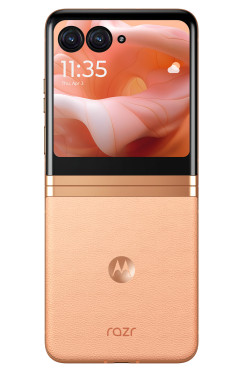
The razr+ Now Comes in the Pantone Color of the Year 2024
Motorola today launched a new color option for its razr+ foldable phone: "Peach Fuzz", which is Pantone’s Color of the Year 2024. Motorola has an exclusive deal with Pantone, and the razr+ is the only model to get this color option in the US. Motorola is offering $300 off for a limited time, bring the price down to $700. The Peach Fuzz razr+ is available starting today exclusively from motorola.com. Motorola also offers the razr+ in the 2023 Color of the Year: Viva Magenta. The razr+ has a large flexible display inside and a large display on the outer cover that uniquely surrounds the cameras.

Motorola Shows Off New Concepts in AI, Foldables
Motorola has new phone hardware and software concepts to show off. Its new foldable phone concept is shaped like company's razr foldable, but folds the other way, with the main display on the outside. Rather than a fixed hinge, the whole center of the phone is flexible, allowing it to be worn around the wrist. The phone can also be bent in specific places to make it stand up at an angle on a tabletop. The software adjusts to offer a full-screen Android interface, part-screen full Android interface, or smartwatch mode. The company is also working on new AI software, including Privacy Content Obfuscation, which uses AI to automatically identify and blur profile pictures and names in outbound social media posts, protecting privacy. Motorola's other new AI features include Text Summarization, an AI-assisted document scanner, and a personal assistant that runs a large language models (LLMs) on-device and continuously learns, to provide better, more personalized answers with greater privacy. In a separate announcement, Qualcomm today announced the first mobile chip capable of running an AI voice assistant powered by a LLM on-device. Motorola's announcements were made at at Lenovo's Tech World '23 event in Austin, Texas.
Qualcomm Aims to Improve Multi-Device Connectivity
Qualcomm has a new technology that aims to make it easier to connect different devices. Snapdragon Seamless is designed to enable a variety of scenarios, including peripheral sharing (your PC keyboard working with your tablet and phone), dragging files and even windows between different types of devices, and earbuds that intelligently switch devices based on audio source priority. Seamless is a "connection-less" protocol that relies on Bluetooth LE and other existing wireless technologies. The technology is designed to be cross-platform, working across Android, Windows, and other platforms. Committed partners include Microsoft, Google, Dell, Lenovo, and Honor. New multi-device features enabled by Snapdragon Seamless are set to arrive on global device platforms starting as early as this year. Snapdragon Seamless is built in to the company's newest chips, including the Snapdragon 8 Gen 3 for phones, S7 for earbuds, and Snapdragon X Elite for laptops.
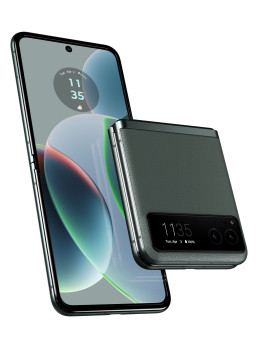
Motorola's new razr Foldable is Just $600
Motorola has announced launch details for its new razr (2023). Not to be confused with the higher-end razr+ that launched earlier this year, the new razr is a more affordable model. In fact, it is, by a wide margin, the most affordable foldable phone to reach the US to date. Motorola will sell it unlocked for $600 for a limited time, with a full retail price of $700. This new model keeps many of the high-end features of the pricier razr+, such as basically the same 6.9-inch flexible main display, 8 GB of RAM, a dedicated 13 megapixel wide-angle camera, wireless charging, and Wi-Fi 6E. Other features include a 64 megapixel main camera and a relatively large battery (4,200 mAh) for a flip-style foldable. The most obvious difference is the smaller outer display. But Motorola has added something new: Motorola Unplugged, a software feature that lets you take "digital breaks" where you choose just a few essential apps that will remain available while everything else disappears. Both AT&T and T-Mobile will offer this new razr, along with Metro by T-Mobile, Cricket, Xfinity Mobile, US Cellular, Boost, and Consumer Cellular. Motorola and most carriers will offer it starting October 19th.

Motorola's Newest Mid-Range Phone Emphasizes Design, Charging
Motorola has announced the edge (2023), a more affordable version of the flagship edge+ (2023) it announced earlier this year. This new mid-range phone keeps the most important features of the edge+, including a large, curved-edge display with HDR10+ and fast refresh. The phone also supports up to blistering 68-watt fast charging, (although the 68-watt charger is sold separately). There's also a 50 megapixel main camera, wide camera, waterproof body, and two-way wireless charging. Also notable is auto-focus on the the front camera, still an unusual spec. Other specs include a 4,400 mAh battery, MediaTek Dimensity 7030 processor, 8 GB RAM, 256 GB storage, NFC, and very good support for all major US 5G and 4G networks. Motorola is selling this model unlocked in the US starting today for $600.
Lenovo ThinkPhone by Motorola Gains New Microsoft Features
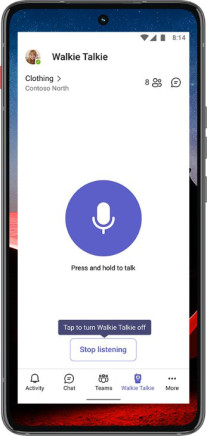
Motorola and Microsoft are bringing new business-oriented software features to the business-focused Lenovo ThinkPhone by Motorola. The new features are: fully integrated support for Windows 365 cloud capabilities, and Push To Talk (PTT) integration with the Walkie Talkie feature on Microsoft Teams. The Windows 365 cloud feature lets users stream a full instance of a Windows PC from the cloud, much like a streaming game service. Users can connect an external display (via USB-C), keyboard, and mouse (via Bluetooth) to the phone for a full desktop experience. The new Teams-based PTT function can be assigned to the Red Key on the side for quick access.

Motorola Defy Satellite Link Now on Sale
The motorola defy satellite link from Bullitt is now available in the US for $150. In North America, the price includes a free trial of the Premium messaging plan (300 non-emergency messages per month) until October 1st, and one year of the Essential plan (30 non-emergency messages per month) for free. The unique device adds satellite connectivity to any Android or iOS smartphone via Bluetooth. This allows that smartphone to send and receive text messages as well as provide location updates in places there is no cellular coverage. Messaging happens in the Bullitt Satellite Messenger app. Message recipients without that app receive a message as a simple SMS to their existing phone, and are invited to download the associated Android or iOS app to respond. Once the free trial(s) expire, there are various annual messaging plans available, starting at $5/month for 30 messages/month. All plans includes SOS Assist, with 24/7 access to emergency response centers. Retailers include AT&T, REI, Bass Pro.com, B&H Photo, Nomadic Supply, BlackOvis.com, and GoHunt.com.
Motorola Gets Serious About Foldables with New RAZR Lineup
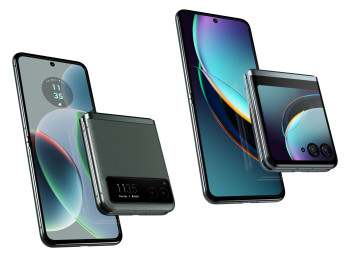
Motorola has launched two new foldable phones, creating a lineup of 2023 razr phones with flexible display technology. The higher-end razr+ has the largest outer display of a modern flip-style phone, and is the thinnest when closed. The design no longer features a "chin", bringing it closer to Samsung's Galaxy Z Flip series in appearance, and Motorola is matching Samsung on price at $1,000. The lower-end model will presumably be more affordable, breaking new ground in the US as a sub-$1,000 foldable at launch. Both new razr phones have the same 6.9-inch AMOLED inner display with FHD+ resolution, HDR10+, and at least 144 Hz refresh (165 Hz for the razr+).
- The 2023 razr+ is powered by a Snapdragon 8+ Gen 1 chip paired with 8 GB of LPDDR5 RAM and 256 GB of UFS 3.1 storage. The large AMOLED outer display surrounds the outer cameras. It measures 3.6 inches and sports 1066 x 1056 resolution, HDR10+, and up to 144 Hz refresh. Motorola has created a new software experience for the large outer display that includes functionality for apps like Google Maps, Google News, Google Wallet, weather, and Spotify. It also has new customization options and even mini-games. The battery is 3,800 mAh. The main camera is 12 megapixel with f/1.5, dual-pixel PDAF, and OIS. Standard colors are Glacier Blue and Infinite Black, both of which employ a 7000-series aluminum frame and Gorilla Glass Victus on both sides. A Viva Magenta (Pantone color of the year) edition swaps out glass for vegan leather on the bottom half. This color will be exclusive to T-Mobile in the US.
- The 2023 razr will be a more affordable option and perhaps the most affordable foldable phone on the market, although Motorola has not yet set a specific price. Its OLED outer display is a more modest 1.5 inches with just 194 x 368 resolution. Powering the phone is a Snapdragon 7 Gen 1 chip paired with 8 GB RAM and 128 GB storage. The main camera is 64 megapixel (f/1.7) with OIS and laser autofocus. Interestingly, the battery is larger at 4,200 mAh. The design consists of 7000-series aluminum, vegan leather, and Gorilla Glass Victus protecting the outer display. It will come in Sage Green, Summer Lilac, and Vanilla Cream.
2023's moto g stylus 5G is Smaller
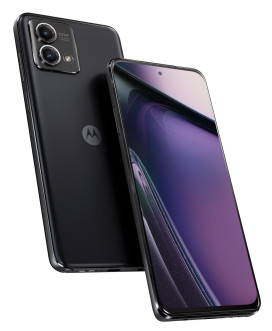
Motorola has launched the 2023 edition of its moto g stylus 5G, a mid-range phone that offers a few extras for $400 (or less through some carriers). This year's model is more compact, with a 6.6 inch display instead of 6.8". It also updates the processor to the newer Snapdragon 6 Gen 1 chip and adds stereo speakers. Other specs and features remain the same, (and a major upgrade over this year's 4G model). That includes the integrated stylus, 120 Hz display, 5,000 mAh battery, 50 megapixel main camera, combined wide/macro camera, NFC, memory card slot, headset jack, and fingerprint reader. The phone has excellent support for all major (sub-6) frequency bands used in the US. It comes with either 4 or 6 GB of RAM and 128 or 256 GB of storage,. It appears to be very popular with carriers. Cricket will sell it starting this Friday, June 2nd. It will also be offered by AT&T, T-Mobile, Metro, Consumer Cellular, US Cellular, Boost, Google Fi, Xfinity, Optimum, and Spectrum.
Hands On with the moto g stylus 5G (2023)
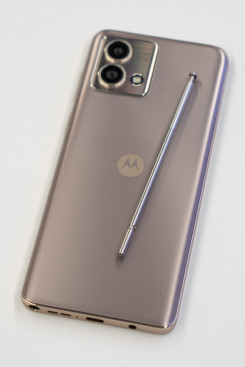
The Moto g stylus 5G has long been one of the few popular mid-range phones in the US. It's a tricky category, but Motorola usually gets it right. So for this year's model, they're not changing much. The 4G model changed a lot this year, but the 5G model is probably closer to what you were expecting, if you follow such things. So what's new, and what's it like in person? Read on for our hands-on report and first impressions.


Hands On with the 2023 moto g 5G & moto g stylus
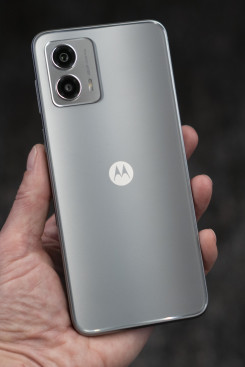
Motorola has two new phones its affordable "g" series, and while at first glance they may seem like basic updates to last year's models, there's more to the story. Motorola has repositioned its 4G moto g stylus to address a different market segment this year, so it has some major differences compared to last year's model. And while the two phones look similar in photos, there are some major differences that become apparent in person. Read all about it in our hands-on report.


Hands On with the Motorola edge+ (2023)
The new Motorola edge+ (2023) is the company's newest flagship phone. It builds on the same formula as last year's model when it comes to features, including dual 50 megapixel cameras. But in terms of design, it's a return to form for the edge series, giving us another curved-edge display after briefly going flat last year. Not only that, but Motorola has doubled down on this aspect, giving us more curved edges all around, as well as a thin body and thin bezels. In photos, this might look like any other phone. But in person... the design might be the phone's best feature; it feels exceptional. We spent some time with it, so allow us to explain in this hands-on report.


Motorola's New Flagship Gets its Signature Edge Back
Motorola has taken the wraps off the new edge+ (2023), its flagship phone for the US this year. This year's model brings back the curved-edge OLED display that was a hallmark of the edge series until last year's model switched to a flat display. The curved sides give the phone slimmer bezels and a narrower body that's easier to hold. Both the front and back are made of Gorilla Glass Victus that's curved on all four edges, helping the phone feel thinner. Also, this year's model is actually thinner at just 8.39 mm. The sandblasted aluminum frame rounds out the IP68 waterproof body, another improvement over last year's model. The fast charging is more than twice as fast at 68 watts, and the battery itself is larger at 5,100 mAh. There's also two-way wireless charging (15W/5W). While the display is still 6.7 inches, HDR10+, and FHD+ resolution, the refresh is faster at 165 Hz. The two 50 megapixel cameras (main and wide/macro) are joined by a new 12 megapixel 2x telephoto "portrait" camera. The front camera is 60 megapixels. Naturally, the processor gets an update to the new Snapdragon 8 Gen 2 from Qualcomm. There's also 8 GB of LPDDR5x RAM and 256–512 GB of UFS 4.0 storage (not expandable). Connectivity includes USB 3.2, Bluetooth 5.3 with LE Audio, NFC, and the phone is Wi-Fi 7 ready. The edge+ supports Motorola's ReadyFor connections to TVs and monitors (wired and wireless). The camera app sports a new 360º "Horizon Lock" feature that mimics a gimbal. Also new are Night Vision and portrait modes for video. The edge+ comes with Android 13, three OS upgrades, and four years of security updates. Boost Infinite and Boost Mobile will be first to offer the new edge+ (2023) starting in one week, May 9th. Spectrum and Consumer Cellular will also offer the phone. An unlocked model with 512 GB storage will be available for $800 starting May 25th (pre-orders May 19). Only one color — Interstellar Black — will be offered in the US.
Motorola Updates its Most Affordable Phones
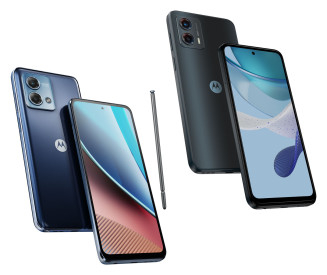
Motorola has introduced two new models in its "moto g" series of affordable phones.
- The moto g 5G (2023) is very similar to last year's moto g 5G, offering 5G for a low price. Updates include 120 Hz display refresh (vs. 90), 15-watt fast charging (vs. 10), and stereo speakers. A Snapdragon 480+ ship replaces the MediaTek Dimensity 700 in last year's model. Other specs are essentially unchanged, including a 6.5-inch, HD+ display and a 48 megapixel camera. It has excellent support for all US networks. It will be available with AT&T, T-Mobile, Cricket, Metro by T-Mobile, Boost Infinite, Boost Mobile, Google Fi Wireless, US Cellular, and Consumer Cellular, with dates and pricing TBA. It will also be available unlocked starting May 25th for $250. Color options are Ink Blue and Harbor Gray.
- The moto g stylus (2023) takes a different approach, cutting some specs to reach a lower price compared to last year's model. The new model is more compact with a 6.5-inch HD+ display and no wide-angle camera. What the new model keeps is the large 50 megapixel main camera, 90 Hz display refresh, and, of course, built-in stylus. It's powered by a MediaTek Helio G85 4G chip. Cricket, Straight Talk, and Walmart Family Mobile will all offer the phone. It will also be available unlocked for $200 starting this Friday, May 5th. It has excellent support for all US 4G networks. It will come in Midnight Blue and Glam Pink.
Lenovo ThinkPhone by Motorola Now Available
The new Lenovo/Motorola phone optimized for business users is available via enterprise channels starting today, and will be available online for consumers starting April 28th. "The Lenovo ThinkPhone by Motorola will be available through select B2B channels in the U.S. beginning April 26. Enterprise consumers can purchase the device through their trusted Lenovo business partner or directly through their Lenovo sales representative." Consumers will be able to purchase the (universally unlocked) ThinkPhone on Motorola.com and Lenovo.com for $700 starting on Friday. It will also be available via Lenovo Pro with "special business pricing".
Motorola's New Affordable 5G Phone Offers a Little More
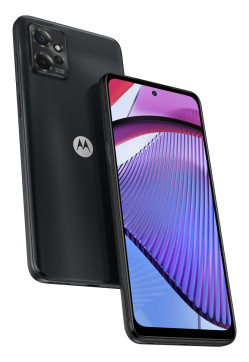
Motorola has announced the moto g power 5G, a $300 5G phone with specs and features that put it somewhere between "entry level" and "mid-range". It has a 6.5-inch full-HD+ display with 120 Hz refresh, a 50 megapixel main camera, and a 16 megapixel front camera. It's powered by a MediaTek Dimensity 930 chip paired with 4 GB of RAM and 128 GB of built-in storage (expandable). The 5,000 mAh battery can be charged quickly at up to 15 watts. (A 10W fast charger is included.) The phone also has a fingerprint reader, headset jack, and stereo speakers. The phone will be available from Metro by T-Mobile, Spectrum Mobile, and Xfinity Mobile in the coming months (pricing and launch dates determined by carriers). The unlocked version goes on sale April 13th for $300, available from Best Buy, Amazon.com, and Motorola.com.

Bullitt Announces First Phones with Satellite Messaging
Bullitt has announced the first Android phones that will include two-way satellite messaging capability. The Motorola defy 2 and CAT S75 are both designed to connect to Bullitt's new Satellite Connect platform. The platform enables two-way messaging via satellite, for both emergency and non-emergency use. The two phone models appear to be essentially the same phone, sporting nearly identical specs and features. Those include sub-6 5G, a 5,000 mAh battery, 15W wireless charging, 6.58-inch FHD+ display with 120 Hz refresh protected by Gorilla Glass Victus, 50 megapixel main camera, 8 megapixel wide camera, and underwater photo capture. Both phones are powered by the MediaTek Dimensity 930 chipset, paired with 6 GB RAM and 128 GB of storage (expandable with memory cards). The phones are rated IP68 and IP69K for water and dirt. They're also military rated for vibration, humidity, salt mist, and thermal shock. The phones come with Android 12 and a promise of three years of quarterly software updates (including two full OS upgrades), and two additional years of "emergency" security updates. The CAT S75 is launching initially in Europe, while the Motorola defy 2 is coming to "selected operators" in North America before the middle of the year. The defy 2 is priced at $599, which includes one year of SOS Assist via satellite. For additional satellite service, "plans start from as little as $4.99/ month". Bullitt also announced the "motorola defy satellite link", a small Bluetooth device that can add the same satellite connectivity to any iOS or Android phone.

New Bluetooth Dongle Lets Any Phone Message via Satellite
Bullitt and Motorola has unveiled the "motorola defy satellite link", a small Bluetooth device that acts as a gateway for two-way satellite messaging, adding that capability to any iOS or Android phone. Using Bullitt's Satellite Messenger service, a connected phone can both send and receive text messages where cellular service isn't available. While it includes an SOS mode, the service is also available for non-emergency use. The device has a rugged, waterproof design and multi-day battery life. It can function independently of a phone with two buttons: an SOS button and a "check in" button that sends your location to a predefined contact. The Motorola defy satellite link will be available globally in April for $99. Service is extra, starting at $4.99/month. Or, for $149, a bundle will be available that in includes the device and one year of service, including SOS Assist and up to 30 non-emergency messages per month.
Bullitt Launches Its Own Two-Way Satellite Messaging Service
Phone maker Bullitt has teamed up with a number of partners to create its own two-way satellite messaging service. An upcoming Motorola Defy-series phone (made by Bullitt) will support the new service and launch in the US soon. Bullitt is offering the service to other manufacturers as well. The Motorola Defy phone will use a MediaTek add-on modem chip that supports NTN (non-terrestrial network) communications. Bullitt is relying on Skylo to provide the satellite service, with is powered by "existing licensed GEO satellite constellations, such as Inmarsat and others." Bullit has created it own messaging app for the service. The app will try using cellular or Wi-Fi networks when available, but fall back to satellite. An emergency SOS service will be free for the first year, and is backed by critical event response specialists FocusPoint International. Subscription plans start at $5/ month for 30 non-emergency messages. SOS messages do not count against the bucket, and shorter messages (including location check-ins) count as fractional messages. When texting other people for non-emergency use, the other person receives a standard text message, but must download a free app to reply and have it relayed by satellite. The app will be available for both Android and iOS. Only the user of the satellite-capable phone is charged for satellite messaging. The service is launching first in the US and Europe, and only provides coverage in launched regions. It reaches far offshore, but not in the middle of the oceans nor polar regions. When in satellite-only coverage, messages via the service are received automatically, unlike some competing solutions. Users should usually not be required to aim the phone to connect to a satellite.

Lenovo ThinkPhone by Motorola Caters to Businesses
Motorola's newest phone is the Lenovo ThinkPhone, a mobile phone designed to appeal to business customers and integrate seamlessly with Lenovo ThinkPad laptops. The ThinkPhone has high-end specs, a durable body, and extensive security features. A full array of connectivity features with ThinkPad laptops includes Instant Connect seamless discovery when nearby, Unified Clipboard, drag-and-drop file sharing, and Instant Hotspot with 5G. Android apps can be opened on the laptop, including launching with one click from Unified Notifications. Advanced Webcam lets you use the phone's 50-megapixel camera for higher-quality online meetings. Other phone specs include a Snapdragon 8+ Gen 1 processor, 8–12 GB RAM, 128–512 GB storage, 6-inch FHD+ OLED display, Wi-Fi 6E, and USB 3.1. It has a 5,000 mAh battery, 68-watt fast charging (68W charger included), and wireless charging. It comes with Android 13 and four years of security updates. A secondary rear camera offers 13 megapixels of 120º wide-angle, while the front camera is 32 megapixel. An aircraft-grade aluminum frame, Kevlar-like "lightweight aramid fiber that's stronger than steel", and Gorilla Glass Victus give the phone durability as well as an IP68 rating for proper water resistance. In addition to ThinkShield and advanced enterprise mobile device management, the ThinkPhone comes with Moto KeySafe, "a separate processor ... that adds an additional layer of security to better protect the most sensitive data in the smartphone. It isolates PINs, passwords, and cryptographic keys, storing them in a tamper-resistant environment protecting the data from the inside out." The ThinkPhone will be available to US business customers and unlocked online "in the coming months". Pricing was not announced.

