

SIM
Subscriber Identity Module
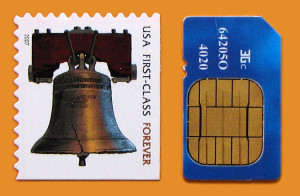
A SIM card is a small plastic card roughly the size of a fingernail that contains a microchip that stores data which identifies the user to the network. Basically, the SIM card is what links a phone to its phone number. The main data that performs this function is the IMSI, a long number stored in the SIM's electronic memory.
See: IMSI
The SIM also contains data used to authenticate and encrypt voice and data transmissions, making it difficult to intercept calls and data as they travel through the air.
The SIM card can be removed by the user and placed in another phone. This will cause the new phone to instantly operate using the subscriber's existing phone number and account (unless the phone is locked.)
See: Locked Phone
SIM cards are typically located in a tray on the edge of the phone that can be ejected with a pin or paperclip. Older phones with removable batteries often have the SIM card in a slot under — or next to — the battery.
SIM cards come in several sizes, including micro-SIM and nano-SIM. Nano-SIM has become standard as of 2021.
See: Micro-SIM
See: Nano-SIM
Instead of a removable card, the functionality of a SIM can also be permanently embedded inside a phone and updated (provisioned) remotely, over the network. This is called eSIM. Some phones have only an eSIM, while others may have both a physical SIM card slot and eSIM capability.
See: eSIM
A SIM card is type of smart card that can store additional information and even very tiny "applications" to process that information. For example, SIM cards can store limited contact information (phone numbers) and authentication for payment systems. Older phones used these features, but modern smartphones do not.
SIM cards were developed as part of the GSM standard, a 2G cellular technology, and have been carried over to newer technologies up to and including 5G phones.
Newer 3G, 4G, and 5G phones technically use an upgraded version of SIM cards called USIM cards, although these are commonly referred to simply as "SIM" cards.
See: USIM